
Overview
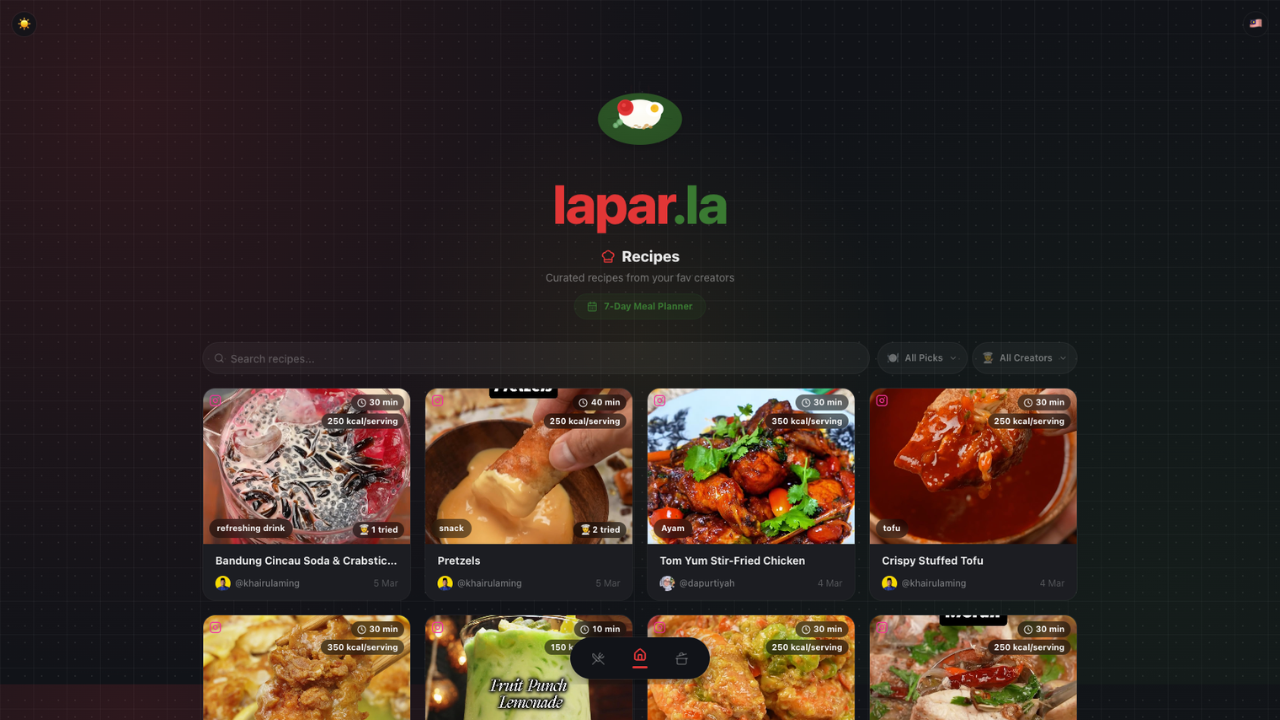
lapar.la is a Malaysian food platform focused on viral creator recipes, designed for users deciding what to cook quickly (“lapar” moments). The app combines a polished, animated frontend with a structured backend ingestion pipeline so social media content can be normalized into searchable, bilingual recipe data.
The system currently emphasizes recipe browsing, quality feedback loops, and admin-assisted content operations, while keeping the original “Makan Out vs Masak In” product vision and navigation structure.
Features
User-facing product
- Bilingual language system (
en/ms) with browser-locale detection, localStorage persistence, and localized UI copy. - Fast recipe discovery homepage with search, creator filters, local-pick filters (sahur, berbuka, budget, quick), and infinite scroll.
- Rich recipe detail pages with ingredient checklists (auto-saved), step tracking, nutrition/cost heuristics, shopping list copy, and creator/source deep links.
- Community feedback loop: “tried it” scoring (thumbs up/down) plus issue reporting with rate limiting and admin status handling.
- 7-day meal planner mode (Puasa/Normal) with local persistence and generated shopping list output.
- PWA behavior: web manifest, service worker caching strategy, install prompt, and push notification hooks.
Admin and content operations
- Password-gated admin dashboard with secure session cookie handling.
- Manual ingestion modes: single Instagram URL, multi-URL batch, and creator-handle ingestion.
- Scheduled ingestion via cron-compatible Node script targeting
/api/ingest. - Creator management tools (avatar curation/upload), recipe CRUD/editing, and report moderation workflow.
- Backfill and localization endpoints for operational data hygiene.
Data and ingestion architecture
- Relational schema in PostgreSQL for recipes, creators, tags, ingestion sources, user try signals, and issue reports.
- Drizzle ORM repository layer and migrations via Drizzle Kit.
- Ingestion pipeline steps:
- Discover/fetch Instagram content (URL or handle timeline)
- Optionally transcribe media audio (OpenAI Whisper, with ffmpeg fallback/chunking)
- Parse structured recipe fields (OpenAI chat parsing with deterministic fallback parser)
- Persist with dedupe protection (unique source URL/hash/platform post IDs)
- Store failures into
.ingest-failuresdead-letter JSON for traceability
Tech Stack
Frontend
- Next.js 16 (App Router), React 19, TypeScript
- Tailwind CSS v4 design system with custom Malaysian color palette tokens
- Framer Motion for transitions, micro-interactions, and animated UI states
- Lucide icons and optimized Next image rendering patterns
Backend and data
- Next.js Route Handlers for API endpoints and admin backend surface
- PostgreSQL as primary datastore
- Drizzle ORM + Drizzle Kit for schema, queries, and migration lifecycle
pgNode driver for Postgres connectivity
Ingestion and AI workflow
instagram-url-directprovider plus Instagram web/oEmbed fallback logic- Optional OpenAI integrations:
- Whisper transcription for video/audio ingestion
gpt-4o-ministructured extraction for recipe parsing and visual hinting
- ffmpeg-assisted compression/chunking for large media transcription reliability
Platform and deployment
- Deployed on VPS with Node.js runtime
- Nginx as reverse proxy in front of the Next.js application
- PostgreSQL hosted for persistent production data
- Cron-based scheduled ingestion job for creator handle sync
- Google Analytics tag integration for traffic instrumentation
Quality and developer workflow
- ESLint configuration for code quality checks
- Type-safe domain models and API payloads across UI and backend
Future Improvements
- Complete the original “Makan Out” geolocation restaurant roulette and social group-vote flow currently stubbed in navigation.
- Add full observability stack (structured logs, alerting, dashboard metrics) for ingestion success rate and API health.
- Introduce queue-based ingestion workers for higher throughput and better retry isolation under larger creator sets.
- Add automated tests (unit + integration + API contract) for parser logic, admin actions, and critical route handlers.
- Expand recommendation quality with personalized signals from try/report data and stronger nutrition estimation models.